
Hello, I'm Dr. Ho Lee, medical director of Glory Clinic, a dermatology clinic in Gangnam where I personally handle every one-on-one consultation and treatment.
Today I'd like to talk about XERF, the hottest radiofrequency lifting device right now, by explaining how it differs from Thermage.
XERF lifting
XERF is a radiofrequency lifting device that came out of the merger between Cynosure, an international company, and Lutronic, a Korean company.
Devices from lesser-known small manufacturers often turn out to be surprisingly rough in the details. XERF lives up to the reputation of Cynosure and Lutronic: it's very pleasant to use, and details such as the interface, how it handles during treatment, and how it feels for the patient have been very well received. That seems to be why it has sold so widely around the world, starting in Korea.
Here I'll explain, simply, how it differs from Thermage — the original radiofrequency lifting device — and who is likely to be happy with XERF.
How XERF differs from Thermage
First, what kind of treatment is Thermage FLX? Take a look at the diagram below.
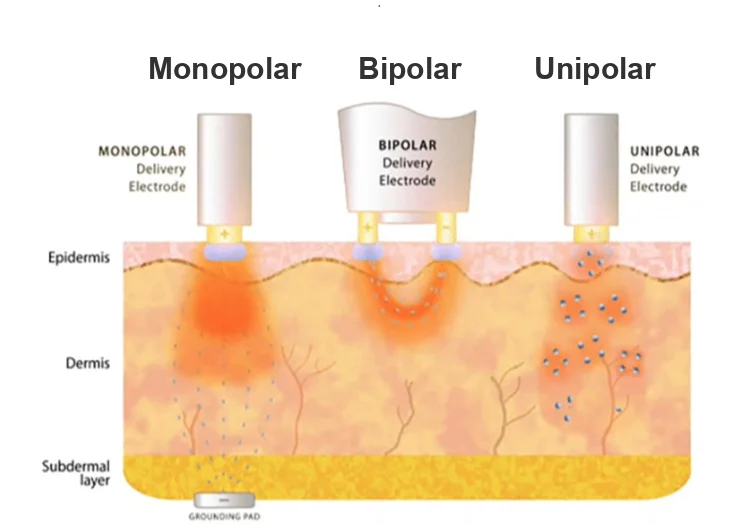
In the diagram, "monopolar RF" shows how Thermage delivers energy into the skin. It reaches a little deeper than bipolar devices (such as Potenza or Secret RF), but only as far as the dermis — Thermage doesn't deliver energy to the subcutaneous fat or the fascia. That's why, to reach those relatively deep layers, Thermage is often combined with Ultherapy. Doing both at once even has a name: "Ulthermage."
XERF, unlike Thermage, adds one distinctive mode, called DEEP mode. Thermage uses 6.78 MHz to deliver energy to the dermis, while XERF also uses a lower frequency of 2 MHz to send energy deeper. Because heat reaches the subcutaneous fat and fascia, it stands apart from Thermage: XERF on its own can deliver energy to the fat and fascia, as Ultherapy does.
So can I just have XERF instead of Ultherapy and Thermage?
Ultherapy delivers energy to the subcutaneous fat and fascia, and Thermage delivers it to the dermis. XERF is fundamentally a radiofrequency treatment like Thermage, so it puts a lot of energy into the dermis while also reaching the fat and fascia, like Ultherapy. It would be wonderful if XERF brought Ultherapy's power along with it, but as a radiofrequency-based device, it doesn't. Ultherapy can deliver energy to those layers strongly enough to destroy fat cells and dramatically tighten the fascia. XERF, being radiofrequency-based, puts far more energy into the shallower dermis than into the deep layers, so it can't reach the deep layers with Ultherapy's intensity.
Can XERF's gentler deep energy be an advantage?
Yes — it can actually work in XERF's favor. Because Ultherapy destroys fat cells and tightens the fascia, it can cause cheek hollowing or, if poorly designed, even make you look older. With XERF, that risk is very low. It doesn't destroy fat cells or tighten the fascia dramatically, so patients don't feel their face shrinking uncomfortably. If losing facial fat worries you a lot, choosing XERF over Ultherapy can put that concern to rest.
If I have Ultherapy, do I still need XERF?
As the diagram shows, Ultherapy delivers energy selectively to the fat and fascia in very narrow lines. XERF, as a radiofrequency treatment, spreads energy evenly across all layers over a wide area — including layers Ultherapy can't reach.
That's why people in their 20s and 30s with good skin elasticity are often very happy with Ultherapy alone. From the late 30s and into the 40s and beyond, many people have lost some elasticity, and they tend to be much happier combining Ultherapy with a radiofrequency treatment that takes care of elasticity — Ultherapy plus Thermage, or Ultherapy plus XERF.
Frequently Asked Questions
Which is better, XERF or Thermage?
If you want to put as much energy as possible into the dermis, choose Thermage. If you want to go beyond elasticity and deliver energy deeper as well, for a lifting effect, XERF is a good choice.
What age groups tend to choose XERF or Thermage?
XERF is popular with people in their 30s and 40s who find Thermage alone a big commitment, and it also suits people in their 50s and 60s who want an effect similar to combining with Ultherapy. Thermage is popular with people over 40, often combined with Ultherapy, and with people over 40 who mainly want better elasticity.
Key Summary
- XERF can deliver some of the combined effect of Ultherapy and Thermage, but it can't fully match Ultherapy.
- People in their 20s to early 30s with good elasticity are often satisfied with Ultherapy alone; once elasticity has declined, adding a radiofrequency treatment such as XERF gives the most satisfying results.
- If Ultherapy's effect on subcutaneous fat worries you, XERF can improve elasticity and lift at the same time while preserving that fat.