
Hello, I'm Dr. Ho Lee, medical director of Glory Clinic, a dermatology clinic in Gangnam where I personally handle every one-on-one consultation and treatment.
Today I'd like to talk about a question many patients ask during consultations: Ultherapy or Thermage — which one suits me better?
Are Ultherapy and Thermage really competing treatments?
Many people ask me, "Doctor, should I have Ultherapy or Thermage?" The first thing to consider is whether these two treatments really compete with each other. Think of deciding between beef and pork for dinner: both are main sources of protein, so to some extent they compete. Unless you're seriously short on protein, you'd normally pick one. But that's not how I see Ultherapy and Thermage. Nobody says, "I can't decide between a bowl of rice (carbohydrate) and beef (protein) today," right? When a patient asks me, "Should I have Ultherapy or Thermage?", that's exactly how the question sounds to me.
What are Ultherapy and Thermage, and how do they relate?
Ultherapy targets the subcutaneous fat layer (3.0 mm) and the fascia (4.5 mm).
Ultherapy is a high-intensity focused ultrasound (HIFU) device that targets the subcutaneous fat layer (3.0 mm) and the fascia (4.5 mm). Sounds technical? High-intensity means powerful, focused means concentrated, and ultrasound is the energy source. In other words, it concentrates strong ultrasound energy on a single depth — 3.0 mm or 4.5 mm.
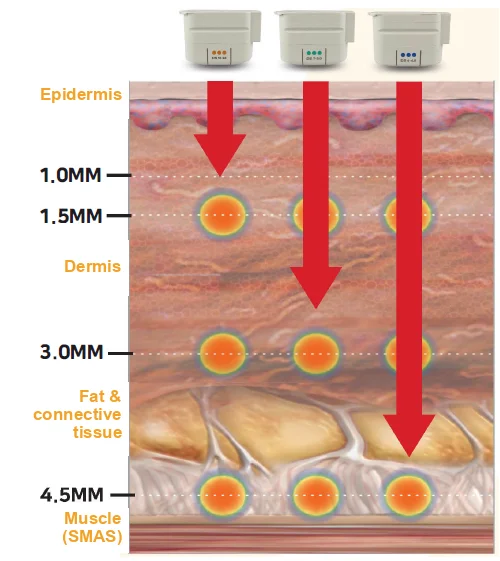
As the diagram shows, depending on the Ultherapy transducer, energy is delivered at 3.0 mm or 4.5 mm, with no energy delivered in between — that is what makes Ultherapy a HIFU device. So Ultherapy's strength is also its weakness: it concentrates energy in the deep layers, but leaves gaps in between.
Thermage concentrates energy in the dermis
Unlike Ultherapy, Thermage delivers radiofrequency (RF) energy into the dermis. Ultherapy skips the skin and delivers energy to the fat and fascia, while Thermage delivers RF energy only to the skin layer (the dermis) that Ultherapy skips. So people whose skin texture has declined, or who want to improve elasticity, texture, and pores, tend to be very happy with Thermage.
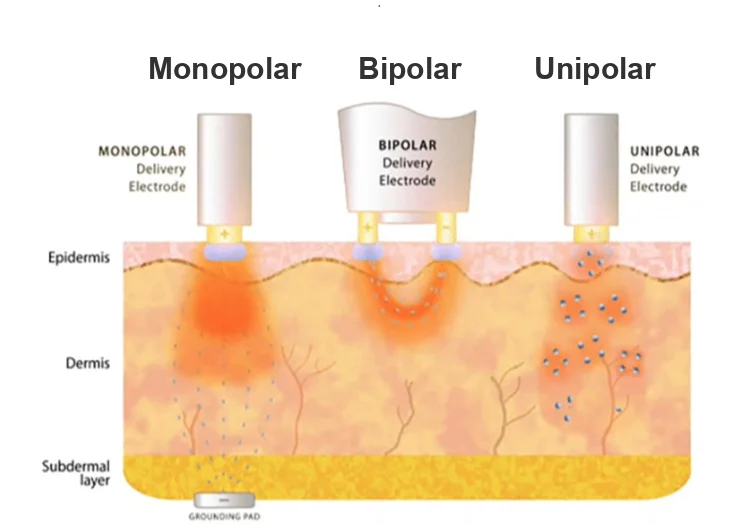
Thermage is a monopolar RF device — the first type shown in the diagram above. Its energy goes mainly into the dermis, labeled "Dermis." Rather than going deep like Ultherapy, Thermage stimulates collagen in the dermis, which is why it is so closely linked to skin elasticity.
How should I choose between Ultherapy and Thermage?
Because the two don't compete but complement each other, making up for each other's weaknesses, it's best to have both when you need both. If cost means you can only choose one, think carefully about where your main need lies and talk it over with an experienced doctor.
If sagging is what you notice most
If you're bothered by heaviness in the lower face and sagging above the nasolabial folds, and you must choose just one, Ultherapy is the better choice. Thermage can improve those areas to some degree too, and having Thermage and Ultherapy together naturally gives more than Ultherapy alone. But if it has to be one, Ultherapy suits this case better.
If elasticity, texture, and pores have declined
If loss of elasticity, more than sagging, is what makes your face look older, Thermage is the better choice. That said, as I mentioned, people whose faces look older from lost elasticity usually also have some unwanted fat and sagging, so most of them need Ultherapy as well. For people who want to choose only one and are afraid Ultherapy will take away their cheek volume, I usually suggest starting with Thermage FLX and finding a separate solution for the sagging later.
Frequently Asked Questions
Is it okay to have both Ultherapy and Thermage?
Yes. As I explained above, Ultherapy targets the deep layers (subcutaneous fat and fascia), while Thermage FLX delivers energy to the skin itself (the dermis). They work at different points and have different core effects, so most people need both.
Is it okay to have just one of them?
As I said, Ultherapy and Thermage target different layers, so their effects differ too. Ideally, have both — at an interval or at the same time — so every layer is stimulated. But because they're expensive treatments, you'll need to talk with your doctor about which device better addresses your needs. Ultherapy prices have also come down a lot while Thermage remains relatively expensive, and when combined with Ultherapy, other treatments can cover part of what Thermage does — so many patients concerned about cost choose Ultherapy combined with a different device.
Key Summary
- Ultherapy and Thermage complement each other rather than compete. You need to understand what each device does to know which to choose. Rather than leaving the recommendation to a consultation coordinator, it's important to understand the treatment through a consultation with an experienced doctor.
- Ultherapy is a lifting device that pulls up the deep layers; Thermage FLX is a tightening device that strengthens the dermis.
- If combining Thermage with Ultherapy is too much of a commitment, you can consider another tightening device instead of Thermage.